

OlivER: Transforming OER Discovery with AI
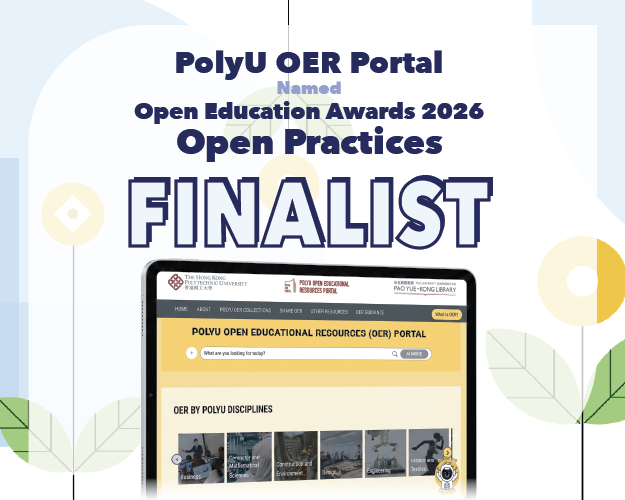
OlivER, an innovative AI chatbot assistant, was embedded in the PolyU Open Educational Resources (OER) Portal. Built on n8n with a local LLM, OlivER uses natural language processing and analysis of course syllabi to map curated OERs directly to specific courses, enabling immediate, curriculum-aligned applications. The PolyU OER Portal was named a finalist for the Open Education Awards for Excellence 2026 (Open Practice category).

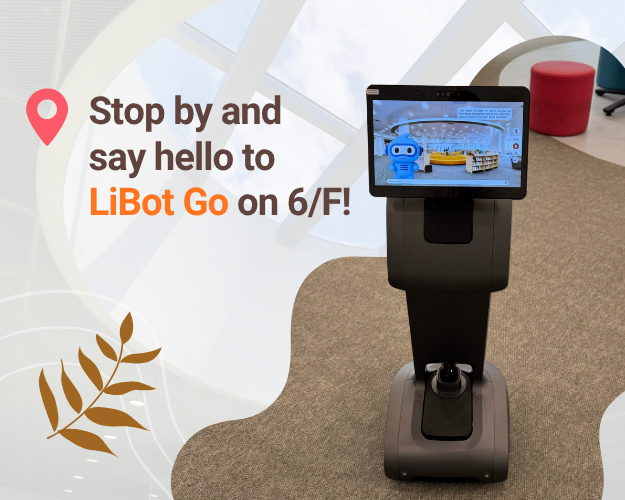
LiBot Go: Mobile Robotics Meets AI Library Support
LiBot Go has joined the Library as a new AI-powered mobile assistant, roaming 6/F South Wing to deliver instant, multilingual answers on Library facilities and services using official website content and guides. By integrating AI with robotics, LiBot Go offers responsive, on-the-spot support, enriching the smart library experience.
AI-powered New Book Recommendations
The AI-powered new book recommendations service is now available in the PolyU Library Mobile App. The localised AI recommendation model uses a linear and non-linear gated framework. It is trained on a set of embeddings derived from the book titles in previous course reading lists and their associated departments. When accessing the Library app, the model will recommend new book titles to users based on their respective departments.

New AI Workstations & Computers at Library i-Space
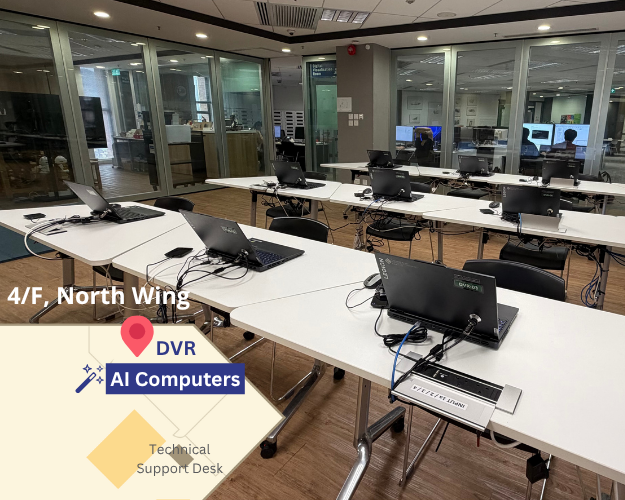
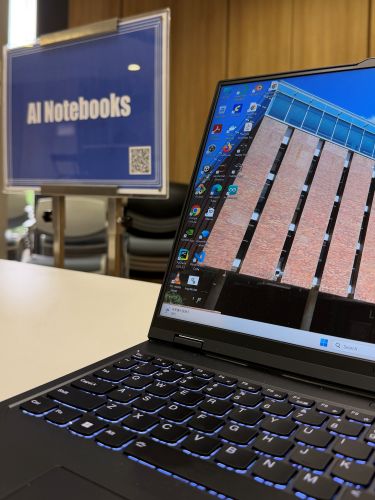
New AI computing facilities, including AI workstations and computers, were provided to support AI learning, development, and research on 4/F i-Space. The facilities are pre-installed with Python, Jupyter Notebook, LLM/API endpoint support, making it easy to incorporate LLM functionalities into applications and workflows.
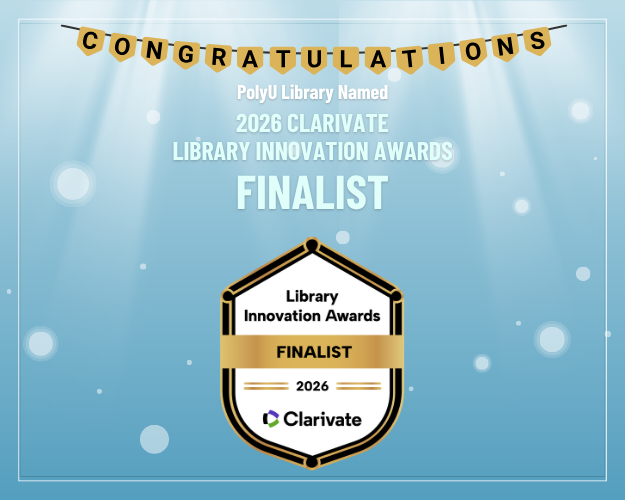
Finalist for the Inaugural 2026 Clarivate Library Innovation Awards
PolyU Library was selected as one of three finalists in the IGeLU Member Category (Academic Libraries - International) for its AI and digital transformation initiatives. This milestone recognises the Library's innovative AI ecosystem, which enhances core functions including resource discovery, learning and research support, operational efficiency, and staff capability building.
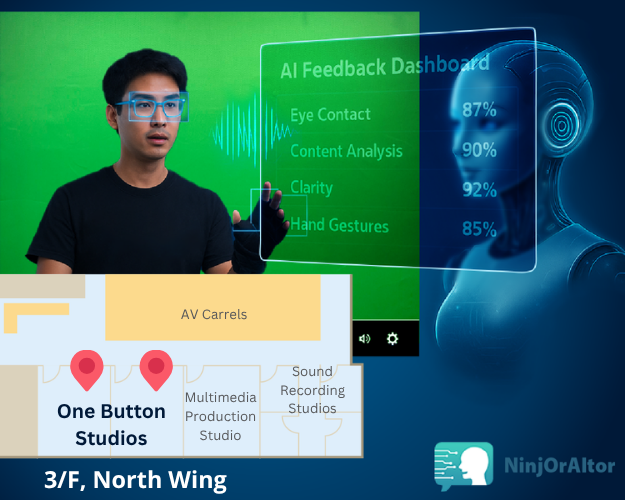
AI-Enhanced One Button Studios - NinjOrAItor
NinjOrAItor at One Button Studio, an AI-powered presentation assessment tool supported by the Department of Electrical and Electronic Engineering, was launched to provide real-time feedback on English oral presentations, covering clarity, content analysis, appropriateness, facial expressions, eye contact, and more.
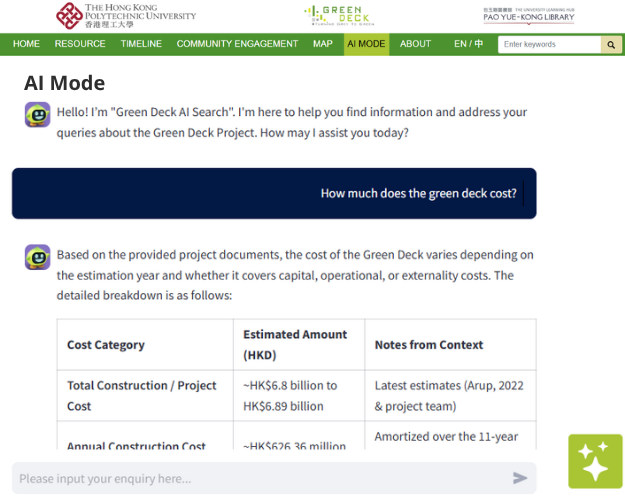
Green Deck Digital Humanities Project Enhancement with AI Search
An AI-enhanced search system for the Green Deck Digital Humanities Project was released to improve the retrieval and discovery of fragmented multimedia and contextual materials across information and data sources.
Final Accepted Manuscript (FAM) Tracking System
The Final Accepted Manuscript (FAM) Tracking System, enhanced with AI preprocessing of Scopus data, was implemented to improve accuracy and accelerate researcher profile and affiliation mapping.
Intelligent Metadata Enhancement with AI
The Library adopted Ex Libris's AI Metadata Assistant, streamlining bibliographic record creation through intelligent suggestions for English-language titles. For Chinese materials, our staff self-developed and AI-assisted workflow using large language models to batch-assign Library of Congress subject headings and call numbers, accelerating the cataloguing process
Primo Recommender List Optimisation with AI
Primo Resource Recommender was enhanced with AI to automatically extract keywords from database descriptions and generate subject recommendations, facilitating resource discoverability and user navigation in the Library OneSearch.
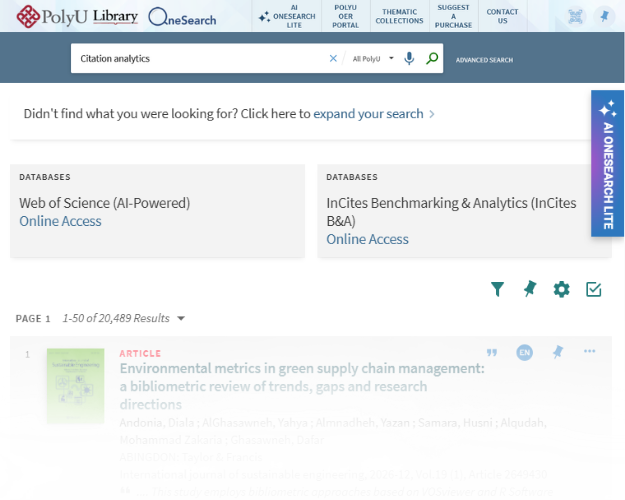
AI-Powered Academic Search - AI OneSearch Lite
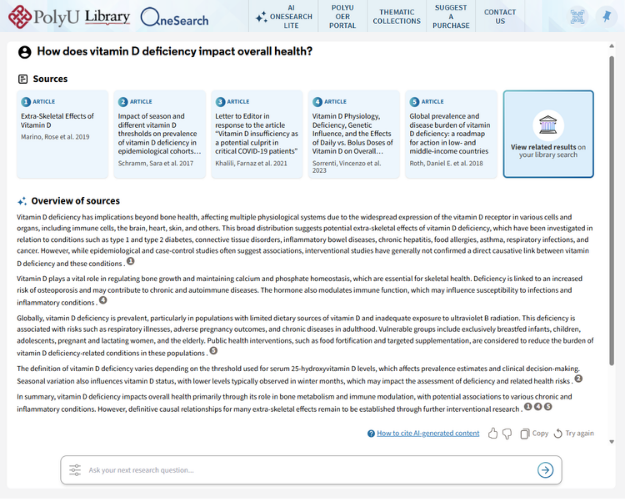
AI OneSearch Lite, a conversational discovery tool within Library OneSearch, was introduced to provide answers from five traceable scholarly sources, suggest new research directions, and support multilingual queries.
LiBot - AI Chatbot and Multimodal Virtual Avatar
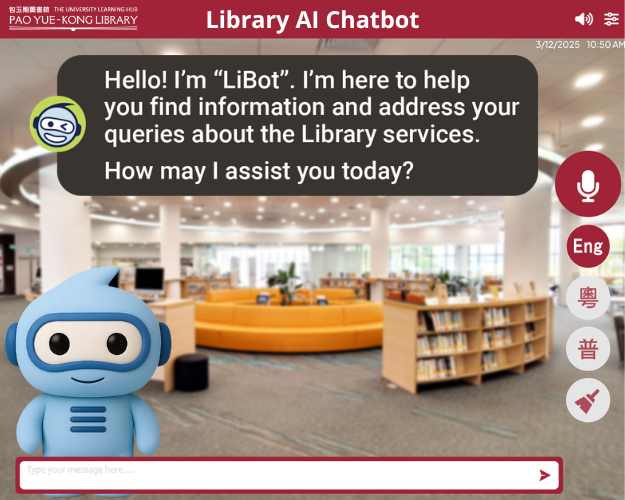
LiBot, a 24/7 AI-powered chatbot, was deployed to deliver instant, reliable answers to service enquiries based on content from the Library website and guides. The service was later enhanced with a Virtual Avatar implementation at the Service Counter, enabling natural voice conversations and speech-to-text recognition in Cantonese, Putonghua, and English.
Embedding AI Literacy Across Curricula
In partnership with academic departments, the Library integrates AI literacy competencies into undergraduate and postgraduate curricula. This embedded approach equips students to use subscribed information and AI tools effectively, critically evaluate generative outputs and source credibility, and understand the ethical dimensions, capabilities, and limitations of AI in academic practice.

 PolyU Library AI Chatbot